Showing posts with label Strange Tribe. Show all posts
Showing posts with label Strange Tribe. Show all posts
Thursday, November 21, 2013
Interview on Public Television station WSRE with Jeff Weeks
Here is a link to an interview I gave on public television while I was in Pensacola in October, http://www.youtube.com/watch?v=B5oXODNQWEw


Tuesday, November 23, 2010
ALL MAN!

Many people still think of Ernest Hemingway in exaggerated terms. Fifty years after his death, he is the Lord Byron of the 20th century, a hyper-macho, rum-drinking, war-mongering, pistol-packing literary giant who married four times, had countless lovers and defined what it was and in many cases still is to be an American male. It is a comfortable and well-worn portrait and, in part, how I imagined him myself growing up as boy in Miami during the 60s and 70s. The larger-than-life image and exploits of the man were certainly more exciting than what you had with many other writers. He was outrageously real, (“too macho to be true” as my dad used to say) in an over-the-top, Quentin Tarantino kind of way. Of course, years later when I wrote Strange Tribe I discovered that Ernest was not at all the person who I thought he was and that perhaps he had more in common with my father, his transsexual youngest son, than with the fishermen, soldiers and bullfighters he was friends with. But even with this knowledge and the publication of my book old ideas die hard. Myths are immortal, I'm inclined to believe, and the exaggerated role that Ernest played in post World War II American culture had a great deal to do with how “Papa” was packaged by the nation's pulp magazines.
This is the fascinating thesis of Professor David M. Earle's recent book, All Man, Hemingway, 1950's Men's Magazine's, and the Masculine Persona (The Kent State University Press, 2009). Reading it, I have to say, answered many of the questions that I've always had about my grandfather and his fame. I knew that Ernest from the 1920's onward was very proactive in molding his image as a sportsman, hunter and connoisseur of wine, women and bulls. He was an ambitious writer, someone who actively sought fame and success. But what Earle does is to show us that not only was Ernest a competent manipulator of the nascent media industry in the US but that he was far from being adverse to publicity, especially from pulp magazines. Ernest started out as a pulp writer, wanted to earn a living writing for them, and while it is true, as most Hemingway aficionados know, that Hemingway submitted many of his short stories to the Saturday Evening Post (all of which were rejected), he was at the same time submitting these pieces to the pulps. Aiming high, but always having a back-up publication for your work, Earle explains, was a common characteristic of pulp writers in the post WWI period.
In Europe, Ernest's writing tackled themes that were decidedly more ambiguous than the stories he'd submitted to the pulp magazines. His portraits of male dysfunctionality and homosexuality such as A Sea Change and A Simple Inquiry are considered some of the best ever written in the English language. Yet, in spite of these works and the view that they provide of my grandfather's complex personality his image as a clear-cut man's man has continued to grow. To a large extent it was his own fault. As Earle shows in All Man, my grandfather “both fought and nurtured his image as a larger-than-life character. In 1930 he made Grosset and Dunlap destroy dust jackets that claimed he had joined the Arditi in the First World War; later he had his editor, Maxwell Perkins, send a letter to correct this information in Paramount studios' press about him for the upcoming A Farewell to Arms. Yet thirty years later these myths were still appearing in interviews and profiles of the author...the image that he put forward in interviews with his quips about meeting international whores and making love until age eighty-five were just as extreme – not so much masculine as a character of hyper-masculine proportions.” In All Man Ernest is just about everywhere in the in the 1950s. Gracing the covers of literally hundreds of magazines, from Focus, which voted him one of the sexiest men in America, to Show, which featured the Hungarian starlet Zsa Zsa Gabor and her list of the ten most “sexciting men” of 1957, Hemingway was hard to ignore. As Zsa Zsa put it “Hemingway's such an outdoor man! So different in every way from women...”.
What was ironic, for me at least, reading the book was to see how Ernest went from being a representative of the Lost Generation and its anti-militarist, anti-conformist themes to someone whose image was used by corporate America to help returning WWII war veterans conform to their roles as suburban husbands and fathers in a conservative, aggressively capitalist nation. Indeed, the alpha-male portrayals of Hemingway filled a cultural need, says Earle, to reaffirm the country's masculinity in an era of “deep-rooted crisis of gender”. Woman had changed during the war, taking on the jobs that their men used to do, and would never again be as submissive as they'd once been. Ernest's past as a wounded veteran and his glamorous lifestyle in Cuba fishing and womanizing could thus be used as a role model and a means of social control. His short stories of WWI soldiers dealing with shell-shock were enormously appealing to a whole new generation of veterans still struggling with their own nightmares, while the sexually ambiguity and relative strength of women in many of his earlier works was conveniently ignored. Ernest certainly hadn't given up writing about male dysfunctionality or his personal search for a more African sexuality “beyond all tribal law” (the Garden of Eden, was written during the 1950s), but he does seem to have understood that he could no longer find a market for the gender bending games of Garden.
Earle's All Man shows us the enormous shadow that Ernest cast over post-war America and at the same time gives us an idea of the intense pressure that he must have experienced living life in the fish bowl of celebrity culture and how this could have only compounded the depression and paranoia that he suffered from in his final years. It is an extremely well-written, and beautifully illustrated book and an important addition to Hemingway scholarship.
Saturday, October 2, 2010
Revista Caras
For any readers who can speak Spanish, an interview of me done by Mauricio Hernandez just came out in Revista Caras (Mexico).
Here are the pages:
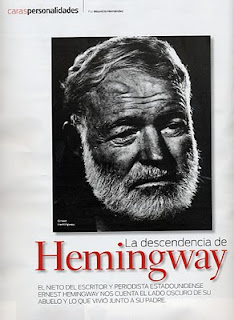


Here are the pages:


Saturday, March 13, 2010
Strange Tribe at the Tucson Festival of Books

For anyone in the Tucson area, I'll be speaking about Strange Tribe this morning at 10 am in the University of Arizona bookstore, at the Tucson Festival of Books. The Festival is being held this weekend with over 400 different authors from the USA and abroad.
Friday, October 9, 2009
Strange Tribe at the Miami Book Fair

I'll be presenting my memoir, Strange Tribe, at the Miami Book Fair on Sunday, November the 15th, at 2:00 in the afternoon. A good part of Strange Tribe takes place in Miami and I'm really looking forward to finally being able to speak about it in my hometown.
Thursday, February 19, 2009
Strange Tribe review from OSU
Here's a review of Strange Tribe that came out on the Ohio State University newspaper, the Lantern, the day before my lecture.
For John Hemingway, having a famous last name wasn't so much a gift as a package deal. Along with that name came a schizophrenic mother, a transvestite father, and a grandfather who, though a brilliant wordsmith, was also a manic-depressive who killed himself.
Hemingway, a writer and translator who lives in Montreal with his wife and two children, will appear at 7 p.m. Tuesday, Feb. 17 at the Wexner Center Film and Video Center to talk about his aptly-named memoir, "Strange Tribe." The appearance and book-signing, sponsored by the Department of English and the Sexuality Studies program, is free and open to the public.

John Hemingway
The memoir represents a son's effort to forgive, to deal with ghosts of his own and help people to understand the troubles and secrets that sifted down through generations of the Ernest Hemingway clan.
"The hardest thing was seeing what happened to them. I wanted to help them, but there was nothing I could do," said Hemingway, in a telephone interview. "It's difficult when you have all that pain wrapped up. How are you going to deal with that? I was thinking, 'I've had enough of that. It's not my problem.' But it is."
His father, Gregory Hemingway, was the youngest of Ernest Hemingway's three sons. The other two boys were blond; Gregory had the dark hair of his mother, Hemingway's second wife, Pauline. Ernest called him by a nickname, "Gigi," took him out shooting, and was proud of his marksmanship.

PHOTO COURTESY OF JOHN HEMINGWAY
From Left: Patrick, Jack, Ernest and Gregory Hemingway pose together. Ernest' grandson, John Hemingway will appear at the Wexner Film and Video Center on Feb. 17 to discuss his recent memoir, 'Strange Tribe.'
But like Ernest, Gregory would suffer from both bi-polar disorder and a drinking problem. He also had a fixation with cross-dressing that began in boyhood. Gregory underwent a series of sexual reassignment surgeries as a man, and eventually took the name of "Gloria."
Gregory Hemingway had too many issues of his own to be a reliable father, so John, who did not inherit his father's manic depression, spent much of his childhood living in Miami with Ernest's brother, Leicester. For years, John alternated between anger at his father and a longing to reconnect with him. He decided to write the memoir after his father's death in Miami in 2001 at the age of 69.
One of the most poignant passages in the memoir is John's recollection about going to the movies with his father. It was a tradition he enjoyed, one of the rare father-son bonding experiences salvaged from a sporadic relationship. Near the end of one of the films, the two of them watched as a troubled character on the screen sat in an office with a gun, put it to his head and pulled the trigger.
At the sound of the shot, Gregory crumpled in his seat, rocking, moaning: "No, no, oh, no." John knew immediately why his father was reacting so strongly: in 1961, Ernest Hemingway, paranoid, depressed, unable to write and in failing health, had committed suicide in similar fashion.
Four Hemingway family members, besides Ernest, committed suicide - his father, sister, brother, and a granddaughter.
In researching the memoir, poring through old family letters and consulting with a new wave of Hemingway biographers, John Hemingway was struck by the similarities between Ernest and Gregory.
"Both were very witty and funny. They could also hold grudges. If you got on their bad side it would take you awhile to get back on their good side," he said. "Both of them were bipolar, and had a lifelong battle to achieve a balance between male and female."
That balancing act, on Ernest Hemingway's part, has been a hot topic among Hemingway scholars since the publication, in 1986, of an unfinished Hemingway manuscript that was stitched into a novel entitled "The Garden of Eden."
In the novel, the main characters, David and Catherine, engaged in sexual role playing in which they get identical haircuts and reverse gender roles in bed: At one point Catherine tells David "Now kiss me and be my girl." Hemingway scholars such as Carl Eby at the University of South Carolina and Debra Moddlemog of Ohio State have written extensively about the roots of Hemingway's fascination with such experimentation, which may reflect a little-known side of the two-fisted writer and macho adventurer.
John Hemingway theorizes that Ernest Hemingway's fascination with his own feminine side softened his attitude toward his gender-bending son. As evidence, he offered a story Gregory told him. It is a story that would ultimately give John Hemingway two gifts: a title for his memoir, and a heightened understanding of the relationship between his troubled father and his world-famous grandfather.
"I think that my dad was around 11 or 12, and he had put on a pair of his mother's nylons," John remembered. "Ernest walked into the room, stared at him for a moment, shocked, then walked out again without saying a word. But a few days later, he looked at Gregory and said: 'Gigi, you and I come from a strange tribe.' "
Hemingway's grandson to bring troubled family tree to Wex through his memoir
Amanda Bishop
Issue date: 2/16/09 Section: Arts
- Page 1 of 1
Hemingway, a writer and translator who lives in Montreal with his wife and two children, will appear at 7 p.m. Tuesday, Feb. 17 at the Wexner Center Film and Video Center to talk about his aptly-named memoir, "Strange Tribe." The appearance and book-signing, sponsored by the Department of English and the Sexuality Studies program, is free and open to the public.
John Hemingway
The memoir represents a son's effort to forgive, to deal with ghosts of his own and help people to understand the troubles and secrets that sifted down through generations of the Ernest Hemingway clan.
"The hardest thing was seeing what happened to them. I wanted to help them, but there was nothing I could do," said Hemingway, in a telephone interview. "It's difficult when you have all that pain wrapped up. How are you going to deal with that? I was thinking, 'I've had enough of that. It's not my problem.' But it is."
His father, Gregory Hemingway, was the youngest of Ernest Hemingway's three sons. The other two boys were blond; Gregory had the dark hair of his mother, Hemingway's second wife, Pauline. Ernest called him by a nickname, "Gigi," took him out shooting, and was proud of his marksmanship.
PHOTO COURTESY OF JOHN HEMINGWAY
From Left: Patrick, Jack, Ernest and Gregory Hemingway pose together. Ernest' grandson, John Hemingway will appear at the Wexner Film and Video Center on Feb. 17 to discuss his recent memoir, 'Strange Tribe.'
But like Ernest, Gregory would suffer from both bi-polar disorder and a drinking problem. He also had a fixation with cross-dressing that began in boyhood. Gregory underwent a series of sexual reassignment surgeries as a man, and eventually took the name of "Gloria."
Gregory Hemingway had too many issues of his own to be a reliable father, so John, who did not inherit his father's manic depression, spent much of his childhood living in Miami with Ernest's brother, Leicester. For years, John alternated between anger at his father and a longing to reconnect with him. He decided to write the memoir after his father's death in Miami in 2001 at the age of 69.
One of the most poignant passages in the memoir is John's recollection about going to the movies with his father. It was a tradition he enjoyed, one of the rare father-son bonding experiences salvaged from a sporadic relationship. Near the end of one of the films, the two of them watched as a troubled character on the screen sat in an office with a gun, put it to his head and pulled the trigger.
At the sound of the shot, Gregory crumpled in his seat, rocking, moaning: "No, no, oh, no." John knew immediately why his father was reacting so strongly: in 1961, Ernest Hemingway, paranoid, depressed, unable to write and in failing health, had committed suicide in similar fashion.
Four Hemingway family members, besides Ernest, committed suicide - his father, sister, brother, and a granddaughter.
In researching the memoir, poring through old family letters and consulting with a new wave of Hemingway biographers, John Hemingway was struck by the similarities between Ernest and Gregory.
"Both were very witty and funny. They could also hold grudges. If you got on their bad side it would take you awhile to get back on their good side," he said. "Both of them were bipolar, and had a lifelong battle to achieve a balance between male and female."
That balancing act, on Ernest Hemingway's part, has been a hot topic among Hemingway scholars since the publication, in 1986, of an unfinished Hemingway manuscript that was stitched into a novel entitled "The Garden of Eden."
In the novel, the main characters, David and Catherine, engaged in sexual role playing in which they get identical haircuts and reverse gender roles in bed: At one point Catherine tells David "Now kiss me and be my girl." Hemingway scholars such as Carl Eby at the University of South Carolina and Debra Moddlemog of Ohio State have written extensively about the roots of Hemingway's fascination with such experimentation, which may reflect a little-known side of the two-fisted writer and macho adventurer.
John Hemingway theorizes that Ernest Hemingway's fascination with his own feminine side softened his attitude toward his gender-bending son. As evidence, he offered a story Gregory told him. It is a story that would ultimately give John Hemingway two gifts: a title for his memoir, and a heightened understanding of the relationship between his troubled father and his world-famous grandfather.
"I think that my dad was around 11 or 12, and he had put on a pair of his mother's nylons," John remembered. "Ernest walked into the room, stared at him for a moment, shocked, then walked out again without saying a word. But a few days later, he looked at Gregory and said: 'Gigi, you and I come from a strange tribe.' "
Wednesday, January 28, 2009
Lecture at Ohio State University
For those of you in the Columbus, Ohio area, I'll be talking about my memoir, Strange Tribe, and all things Ernest at OSU's Wexner Center Film/Video Theatre on February 17th at 7:00 pm.


Tuesday, July 29, 2008
Solidarity for Ronaldo and Hemingway
Living in Milan for as many years as I did, I learned a lot about “Ronaldo” or The Phenomenon as he is commonly referred to in Europe and in Brazil. Soccer is religion in Italy and when one of the two professional teams in the city, F.C. Internazionale Milano (Inter, for short), bought the Brazilian player in the summer of 1997 from F.C Barcelona the media barrage that covered the trade, and thereafter everything about Ronaldo’s life on and off the field, was intense.
 Ronaldo
Yet, as famous as Ronaldo was, and continues to be, I never thought I’d see the day when he would be compared to my grandfather. Then in May a friend suggested that I have a look at a column on the Folha de Sao Paulo. The article, “Solidarity for Ronaldo and Hemingway”, was written by Contardo Calligaris, an Italian psychoanalyst and novelist. Calligaris (who lives in Brazil) said that he was surprised to see a message spray-painted at the entrance to a tunnel near a favela in Rio, Ronaldo’s hometown. Some of the soccer player’s fans had written that they “believed in his innocence” and that he would always remain their “phenomenon.” At the time, Ronaldo was at the center of a scandal involving three transvestite prostitutes who had spent a night with him in a hotel. He claimed that he had been tricked and that he had no idea that they were men. They retorted that he was just trying to get out of paying them.
Calligaris asked “but what kind of innocence are we talking about here?” Ronaldo hadn’t committed any crime and his status as a “phenomenon”, strictly speaking, was related to his performance on the playing field and not with anything he might have done in one of the city’s lesser-known hotels. Calligaris reasoned that for his fans Ronaldo wasn’t just a soccer player but also a “macho ideal” and that as such it was necessary for them to continue believing in his “innocence.”
He then said that he’d read my memoir, Strange Tribe, and pointed out to his readers that Ernest Hemingway, another macho ideal, was perhaps not entirely the man that everyone believed him to be and that he may have struggled as much as Ronaldo has recently in dealing with the contradictions between his public image and an infinitely more complex private reality.
 Ernest in the 1950's
Of course, I hardly needed to be convinced. It was my book that he was talking about, but more than that I had seen what my father had gone through trying to live up to the macho image that Ernest had helped to create. Gregory had done all the things that people generally associate with being a Hemingway; hunting, fishing, drinking and womanizing, and there were times when he had even surpassed his father. At the age of eleven he tied for first place in a national skeet-shooting contest in Cuba, against adults. Gregory was an incredible shot and a chip off the old block, as far as Ernest was concerned. Any kid who could handle a gun that well had to be a real Hemingway. But there was more to being a member of this club of sharpshooters than met the eye. My grandfather and father shared a fascination with androgyny, or as Ernest had the protagonist of his posthumous novel the "Garden of Eden” put it, a search for “a more African sexuality, beyond all tribal law.” They were machos, but with a twist. Men more interested in finding a union of the sexes, than in living on just one side of the gender divide.
It was similarity that united them and which, at the same time, complicated their relationship tremendously. They were mirror images of each other, but being a real man has never been easy.
 Ronaldo
Yet, as famous as Ronaldo was, and continues to be, I never thought I’d see the day when he would be compared to my grandfather. Then in May a friend suggested that I have a look at a column on the Folha de Sao Paulo. The article, “Solidarity for Ronaldo and Hemingway”, was written by Contardo Calligaris, an Italian psychoanalyst and novelist. Calligaris (who lives in Brazil) said that he was surprised to see a message spray-painted at the entrance to a tunnel near a favela in Rio, Ronaldo’s hometown. Some of the soccer player’s fans had written that they “believed in his innocence” and that he would always remain their “phenomenon.” At the time, Ronaldo was at the center of a scandal involving three transvestite prostitutes who had spent a night with him in a hotel. He claimed that he had been tricked and that he had no idea that they were men. They retorted that he was just trying to get out of paying them.
Calligaris asked “but what kind of innocence are we talking about here?” Ronaldo hadn’t committed any crime and his status as a “phenomenon”, strictly speaking, was related to his performance on the playing field and not with anything he might have done in one of the city’s lesser-known hotels. Calligaris reasoned that for his fans Ronaldo wasn’t just a soccer player but also a “macho ideal” and that as such it was necessary for them to continue believing in his “innocence.”
He then said that he’d read my memoir, Strange Tribe, and pointed out to his readers that Ernest Hemingway, another macho ideal, was perhaps not entirely the man that everyone believed him to be and that he may have struggled as much as Ronaldo has recently in dealing with the contradictions between his public image and an infinitely more complex private reality.
 Ernest in the 1950's
It was similarity that united them and which, at the same time, complicated their relationship tremendously. They were mirror images of each other, but being a real man has never been easy.
Monday, July 14, 2008
El Doble
Yesterday was the 84th anniversary of the first recorded death in an encierro during the Fiesta de San Fermin. Esteban Domeño was mortally wounded by a bull in Calle Estafeta and I know about this not because I’m any sort of historian of these tragic events but because of a chance encounter I had.
I was walking down Calle Estafeta towards the curve and had stopped to look at something in one of the stores when my friend, Josep Molina, tapped me on the shoulder and said that there were two filmmakers up ahead that I should meet. It was eleven o’clock and I had already done three interviews that morning but Josep promised me that this had nothing to do with the press or photo ops. They had an interesting idea, he said.
Sergio Oksman and Carlos Muguiro, in fact, were shooting a film about my grandfather and had been inspired by a photograph taken just moments before Domeño’s death in Calle Estafeta. In the photo another young man, Pablo Guerendiain, has been wounded by the bulls and is lying in a fetal position just in front of the store that his father owned. At the same time all this was happening, and just out of the picture, my grandfather was probably watching the bulls and the runners from the balcony of his room in the Hotel La Perla. It was where he stayed when he came to Pamplona and while no one can prove that he was actually there that morning, Ernest had a talent for always finding the best place to be, whatever the occasion, and you really couldn’t find a better observation post than a balcony on the second floor of the Hotel La Perla.
The film then explores the idea of the “double” or what normally lies beyond our field of vision and how often in life what we can’t see, the hidden part of our existence, is as interesting and important as what we do see. In this case we have two young men who compliment each other, Pablo Guerendiain, immobilized and looking at nothing as he prays that any remaining bulls will ignore him, and Ernest Hemingway looking at Pablo and taking in the rush of events that would leave another young man dead on the cobblestones.
Sergio and Carlos sent me a treatment of their story and as I read it and looked at the photograph that had inspired them I thought that it had a lot to do with Ernest’s theory of writing, i.e. that ninety percent of any tale lies just below of what you can see. It is the hidden element of our day to day existence, the unconscious undertow of emotions and events that pulls us along. It is something that we rarely see and when we do we are shocked to have it there in front of us, this shadow of ourselves, a true reflection of who we are.
My memoir, Strange Tribe, from this point of view is another examination of ones “doubles”. I needed to understand my father Gregory and what had gone on between him and my grandfather before I was born (outside of my field of vision), to see how their battle had impacted on my own life. I needed to see clearly the tragic story of two men who were so similar and who loved each other so much that they reached a point where communication was impossible. A family history that perhaps isn’t so different from many others, universal in its own way.
I was walking down Calle Estafeta towards the curve and had stopped to look at something in one of the stores when my friend, Josep Molina, tapped me on the shoulder and said that there were two filmmakers up ahead that I should meet. It was eleven o’clock and I had already done three interviews that morning but Josep promised me that this had nothing to do with the press or photo ops. They had an interesting idea, he said.
Sergio Oksman and Carlos Muguiro, in fact, were shooting a film about my grandfather and had been inspired by a photograph taken just moments before Domeño’s death in Calle Estafeta. In the photo another young man, Pablo Guerendiain, has been wounded by the bulls and is lying in a fetal position just in front of the store that his father owned. At the same time all this was happening, and just out of the picture, my grandfather was probably watching the bulls and the runners from the balcony of his room in the Hotel La Perla. It was where he stayed when he came to Pamplona and while no one can prove that he was actually there that morning, Ernest had a talent for always finding the best place to be, whatever the occasion, and you really couldn’t find a better observation post than a balcony on the second floor of the Hotel La Perla.
The film then explores the idea of the “double” or what normally lies beyond our field of vision and how often in life what we can’t see, the hidden part of our existence, is as interesting and important as what we do see. In this case we have two young men who compliment each other, Pablo Guerendiain, immobilized and looking at nothing as he prays that any remaining bulls will ignore him, and Ernest Hemingway looking at Pablo and taking in the rush of events that would leave another young man dead on the cobblestones.
Sergio and Carlos sent me a treatment of their story and as I read it and looked at the photograph that had inspired them I thought that it had a lot to do with Ernest’s theory of writing, i.e. that ninety percent of any tale lies just below of what you can see. It is the hidden element of our day to day existence, the unconscious undertow of emotions and events that pulls us along. It is something that we rarely see and when we do we are shocked to have it there in front of us, this shadow of ourselves, a true reflection of who we are.
My memoir, Strange Tribe, from this point of view is another examination of ones “doubles”. I needed to understand my father Gregory and what had gone on between him and my grandfather before I was born (outside of my field of vision), to see how their battle had impacted on my own life. I needed to see clearly the tragic story of two men who were so similar and who loved each other so much that they reached a point where communication was impossible. A family history that perhaps isn’t so different from many others, universal in its own way.
Friday, July 11, 2008
Entrevista en El País
Here's an interview that I did with the Madrid daily "El País". The reporter (Quino Petit) and I talked about the morning's encierro, my impression of Pamplona and the Fiesta and about my book, Strange Tribe.
Tuesday, July 1, 2008
Oh Canada!
I’ll never forget the first time I found out about “Canada Day”. It was July 1st, 1985 and I was in sitting in the living room of my father’s apartment in Missoula, Montana watching TV. Gregory Hemingway had separated from his third wife about a year before and while he’d seemed a bit nervous when we’d met in June, I think that he was happy to have me there. He was full of plans and in the evenings after he’d finish his work as a doctor at the state prison in Deerlodge, he’d let me in on all the things we were going to do, the countries we’d visit, the car he would get me, the local university that I would enroll in for my Masters and the house that he would buy for the two of us should I decide to stay.
My dad was bi-polar and had I known more about his condition back then I’m sure that I would have seen all his extravagant promises and ever-increasing energy as early warning shots across the bow. He could only get worse and finally “crash” before slipping into another deep depression that might last months if he didn’t undergo ECT (electro-convulsive therapy).
That morning I was wondering where he was. He’d hadn’t come home the night before, nor had he called to say that he’d be back late and that I shouldn’t wait up for him. I figured that eventually he would show up and grabbed a box of donuts from the fridge and had breakfast as the Canadian ambassador in Washington fielded questions from an audience of American college students on the Today Show. What did the Ambassador think of the US and Americans in general, how strong was the relationship between the two countries and did Canada have a president and if so who was he? The Ambassador said that Canada was a constitutional monarchy and that the Queen of England was its head of state, and it was right about then when the front door opened and I saw my dad peek inside wearing what looked like a blond wig. I think he was surprised to see me because he closed the door almost as quickly as it had opened.
I sat there in my chair as the college students continued to ask their questions on TV and I thought, “Was that Greg?” I had heard from a step-brother a few years before that he liked to put on make-up and my mother had once told me that when she had been married to him he would cross-dress, but hearing about his exploits was one thing, seeing him actually do it quite another.
A few minutes later the door opened again and my father walked in, this time without the wig and holding his high heel shoes. He was wearing a silk dress and had a serious look on his face as he passed in front of me. He was pretending that I wasn’t there, his lips pursed in a kind of grimace as his muscular body turned and he slowly started to walk up the stairs to the bedroom.
I continued watching the Today Show and didn’t say anything, and when he eventually came down, having changed into a pair of shorts and a t-shirt, he didn’t offer any explanations. In retrospect, it was an important moment in my understanding, subconsciously at least, that there was much more to being a Hemingway than I was aware of and that the dividing line between my father and my grandfather’s essential character was not nearly as great as most people might think. My family truly was, as Ernest had once described it, a Strange Tribe.
My dad was bi-polar and had I known more about his condition back then I’m sure that I would have seen all his extravagant promises and ever-increasing energy as early warning shots across the bow. He could only get worse and finally “crash” before slipping into another deep depression that might last months if he didn’t undergo ECT (electro-convulsive therapy).
That morning I was wondering where he was. He’d hadn’t come home the night before, nor had he called to say that he’d be back late and that I shouldn’t wait up for him. I figured that eventually he would show up and grabbed a box of donuts from the fridge and had breakfast as the Canadian ambassador in Washington fielded questions from an audience of American college students on the Today Show. What did the Ambassador think of the US and Americans in general, how strong was the relationship between the two countries and did Canada have a president and if so who was he? The Ambassador said that Canada was a constitutional monarchy and that the Queen of England was its head of state, and it was right about then when the front door opened and I saw my dad peek inside wearing what looked like a blond wig. I think he was surprised to see me because he closed the door almost as quickly as it had opened.
I sat there in my chair as the college students continued to ask their questions on TV and I thought, “Was that Greg?” I had heard from a step-brother a few years before that he liked to put on make-up and my mother had once told me that when she had been married to him he would cross-dress, but hearing about his exploits was one thing, seeing him actually do it quite another.
A few minutes later the door opened again and my father walked in, this time without the wig and holding his high heel shoes. He was wearing a silk dress and had a serious look on his face as he passed in front of me. He was pretending that I wasn’t there, his lips pursed in a kind of grimace as his muscular body turned and he slowly started to walk up the stairs to the bedroom.
I continued watching the Today Show and didn’t say anything, and when he eventually came down, having changed into a pair of shorts and a t-shirt, he didn’t offer any explanations. In retrospect, it was an important moment in my understanding, subconsciously at least, that there was much more to being a Hemingway than I was aware of and that the dividing line between my father and my grandfather’s essential character was not nearly as great as most people might think. My family truly was, as Ernest had once described it, a Strange Tribe.
Tuesday, June 24, 2008
What I do
This is my very first posting, and before I start I'd like to thank my wife, Ornella, for encouraging me to do this. She's been after me for months, no, make that years to get a blog set up. Up to now I've been writing for other sites, magazines and a few newspapers, mostly in Italy.
I live in Montreal, in the Hochelaga/Maisonneuve neighborhood. It's a very french part of town where hardly anyone speaks English. All the Quebec nationalists on the island live out here. It's a poor section of the city, many families are on welfare, but the people are very friendly. As for the weather, in the summer it's very green with lots of trees and overgrown gardens. The winters, on the other hand, tend to be brutal. They last about five months out of the year and are extremely cold and full of snow.
I'm not from Montreal. I'm not even a Canadian. I was born in Miami and spent most of my childhood there. The other big chunk of my life was spent in Europe. Twenty-two years in Italy and a year in Spain.
While in Milan I started and finished Strange Tribe, a memoir about my father Gregory Hemingway and his dad, Ernest Hemingway. Click here to see a review from Curledupwithagoodbook.com which I think gives you a pretty good feel for the book.
Bene, per oggi questo e' tutto.
I live in Montreal, in the Hochelaga/Maisonneuve neighborhood. It's a very french part of town where hardly anyone speaks English. All the Quebec nationalists on the island live out here. It's a poor section of the city, many families are on welfare, but the people are very friendly. As for the weather, in the summer it's very green with lots of trees and overgrown gardens. The winters, on the other hand, tend to be brutal. They last about five months out of the year and are extremely cold and full of snow.
I'm not from Montreal. I'm not even a Canadian. I was born in Miami and spent most of my childhood there. The other big chunk of my life was spent in Europe. Twenty-two years in Italy and a year in Spain.
While in Milan I started and finished Strange Tribe, a memoir about my father Gregory Hemingway and his dad, Ernest Hemingway. Click here to see a review from Curledupwithagoodbook.com which I think gives you a pretty good feel for the book.
Bene, per oggi questo e' tutto.
Subscribe to:
Posts (Atom)